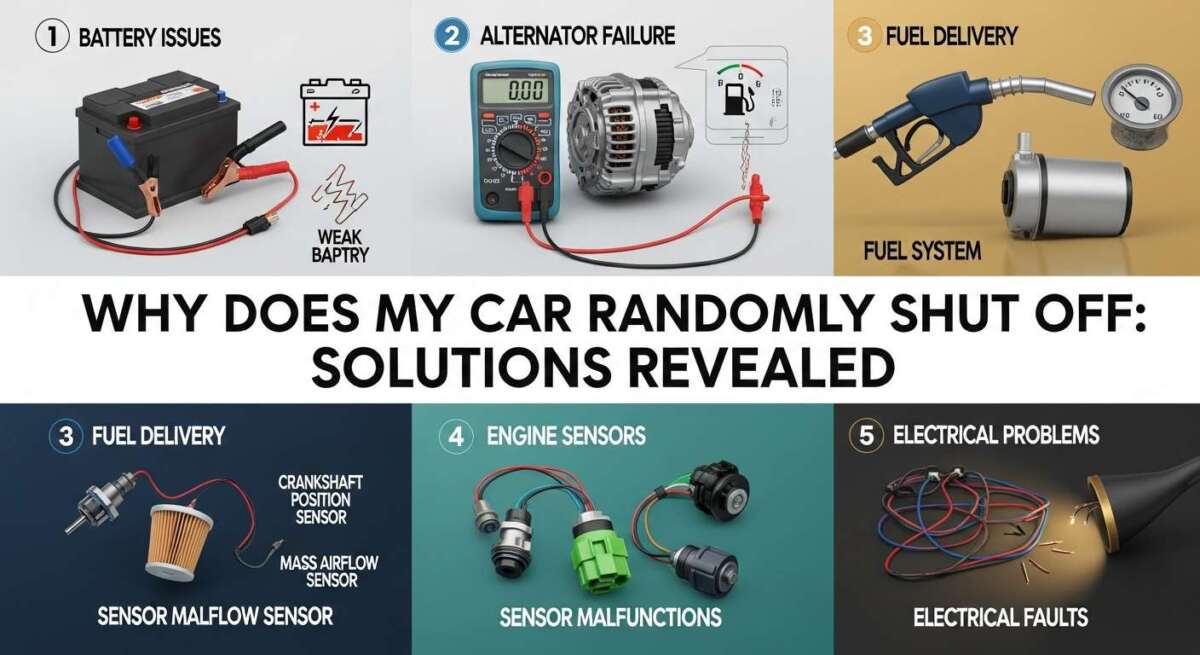
Why Does My Car Randomly Shut off: Solutions Revealed
Imagine this. You are driving down the highway. The radio is on. The sun is out. You feel good. Then, silence. The engine stops. The power steering gets heavy. The gas pedal does nothing.
It is scary. I know it is. I have been there.
My name is Dan. I have fixed cars for twenty years. I have seen this happen to new cars and old trucks. You ask, “Why does my car randomly shut off?” You are not alone. It is a very common problem. But we can fix it.
In this guide, I will talk to you like a friend. I will skip the big fancy words. We will look at why this happens. We will look at how to fix it. We will make your car safe again.
Let’s get your car back on the road.
Safety First: What To Do Right Now
Before we fix the car, we must keep you safe. If your car dies while you drive, you must act fast. But you must stay calm.
Don’t Panic
Panic is your enemy. Your car will feel different. The steering wheel will feel heavy. The brakes will feel hard. This is normal. The engine helps power these things. When the engine stops, the help stops. But you can still steer. You can still brake. You just need to push harder.
Get Off the Road
Turn on your hazard lights. This tells other drivers you have a problem. Look for a safe spot. Aim for the shoulder of the road. If you are in the city, aim for a parking lot. Do not stop in the middle of the road if you can help it.
Try to Restart
Once you are safe, put the car in Park. Turn the key off. Wait a minute. Try to start it again. Sometimes, it is a glitch. If it starts, drive to a mechanic. If it does not start, do not force it. You might kill the battery. Call for help.
The Big Three: Air, Fuel, and Spark
To run, an engine needs three things. We call this the “Combustion Triangle.”
- Fuel: Gas to burn.
- Air: Oxygen to mix with gas.
- Spark: Fire to light the mix.
If you lose one, the car dies. It is that simple. Most random shut-offs come from losing one of these. We will check them one by one.

Credit: www.youtube.com
Fuel System Issues: Is Your Car Hungry?
The most common reason a car stops is a lack of fuel. It is like running a marathon without water. You will pass out. Your car does the same.
The Empty Tank Myth
This sounds silly. But check your gas gauge. Is it working right? I once took apart a whole engine. The problem? The owner was out of gas. The gauge was broken. It said “Half Full.” The tank was bone dry.
Pro Tip: If your car is old, tap the gauge. Does the needle move? If you are unsure, add a gallon of gas. See if it starts.
The Silent Fuel Pump
The fuel pump lives in your gas tank. It pushes gas to the engine. It works very hard. Over time, it gets tired.
Symptoms of a Bad Pump:
- The car whines or hums loudly from the back.
- The car sputters at high speeds.
- Car stalls while driving up a hill.
If the pump dies, the gas stops. The engine shuts off instantly.
How to Test It:
Sit in the car. It must be quiet. Turn the key to “On.” Do not start the engine. Listen carefully. Do you hear a soft hum for two seconds? That is the pump priming. If you hear silence, the pump might be dead.
Personal Story: The Hill Climb Stutter
I want to share a story. It was 2015. I was driving my old pickup truck. I was going up a steep hill. Suddenly, the truck jerked. It felt like someone pulled it back. Then, it died.
I managed to pull over. I was confused. The truck ran fine on flat ground. I checked the oil. Good. I checked the battery. Good.
I towed it home. I opened the fuel tank. The problem was the “sock.” This is a little filter on the fuel pump. It was covered in mud and rust. The pump could not suck gas through the mud. On the hill, the gas moved back, and the pump sucked air.
I cleaned the tank. I put in a new filter. The truck ran like new. This taught me a lesson. Dirt is a killer.
Clogged Fuel Filters
Your car has a fuel filter. It cleans the gas before it hits the engine. Gas stations have dirty tanks. Your filter catches this dirt.
If the filter gets clogged, gas cannot pass. It is like drinking a milkshake through a tiny straw. You can’t get enough. Your engine starves.
Signs of a Clogged Filter:
- The car starts but dies quickly.
- Rough idling.
- The car lacks power when you pass someone.
Changing a fuel filter is cheap. It is easy. It saves your fuel pump from working too hard.
Dirty Fuel Injectors
Injectors spray gas into the engine. They have tiny holes. These holes can get plugged with carbon. Carbon is like soot.
If the spray is bad, the fire is weak. The engine might shake. It might shut off at a red light.
The Fix:
Try a bottle of fuel injector cleaner. You pour it into your gas tank. It cleans the injectors while you drive. It costs less than ten dollars. It works well for small clogs.
Electrical Gremlins: The Spark of Life
If the fuel is fine, we look at power. Cars today are giant computers. They need steady electricity. If the power blinks, the car dies.
The Battery Connection
People blame the battery first. But a car can run without a battery if the alternator works. However, a loose battery helps no one.
The Wiggle Test:
Open your hood. Grab the battery cables. Wiggle them. Do they move? They should not. If they move, they are too loose.
If a cable disconnects while you hit a bump, the car loses its brain. The engine shuts off.
The Fix:
Get a wrench. Tighten the bolts. Make sure the metal is clean. Look for white powder. That is corrosion. Clean it with baking soda and water. It is a simple fix.
Bad Alternator Symptoms
The alternator is a generator. It charges the battery. It powers the radio, lights, and spark plugs while you drive.
If the alternator dies, the car runs on the battery. This lasts maybe ten minutes. Then, everything dies.
Signs of a Bad Alternator:
- Car shuts off but lights work (at first, then they dim).
- The “Battery” light turns on the dash.
- Headlights get dim when you stop.
- A growling sound from the engine belts.
If you see these signs, go to a shop. They can test it for free. Do not wait. A bad alternator kills a good battery.
The Ignition Switch
This is a tricky one. The ignition switch is behind where you put your key. It sends power to the whole car.
If the switch is worn out, it can cut power.
Do you have a heavy keychain?
I see this often. People have twenty keys on one ring. The weight pulls on the switch. Over years, it breaks the inside.
The Test:
Start the car. Wiggle the key gently. Does the car die? If yes, you need a new switch. And please, lighten your keychain. Keep only the car key on it.
Fuse Box Check
Sometimes, the problem is tiny. A fuse is a safety wire. If too much power flows, it melts. This saves the car from fire.
Check your owner’s manual. Find the fuse for “ECM” (Engine Control Module) or “Fuel Pump.”
Pull the fuse out. Look at the metal strip inside. Is it broken? Is it black? If so, replace it. Fuses cost pennies. It might be the easiest fix of all.

Credit: www.reddit.com
Air Intake and Sensors: The Brains of the Operation
We checked fuel. We checked power. Now we check the air. Your car needs to breathe. It also needs to know how much it is breathing. This is where sensors come in.
Sensors are the eyes and ears of the car’s computer. If they lie, the computer gets confused. It might shut the engine off to “save” it.
Mass Airflow Sensor (MAF)
This sensor sits near your air filter. It counts the air going into the engine. The computer uses this count to add the right amount of gas.
The Problem:
The MAF sensor gets dirty. Dust, oil, and pollen stick to it. If it gets dirty, it gives wrong numbers. The computer adds too much air or too little gas. The engine chokes.
Keyword Scenario: Car dies while idling
If your car starts fine but dies at a stop sign, check the MAF.
The Fix:
You can clean it yourself. Buy a can of “MAF Sensor Cleaner.”
- Open the air box.
- Unscrew the sensor.
- Spray the wire gently. Do not touch it! It is fragile.
- Let it dry. Put it back.
This takes ten minutes. It can solve many stalling problems.
Idle Air Control (IAC) Valve
When you take your foot off the gas, the throttle closes. So, how does the engine get air? The Idle Air Control (IAC) valve. It is a little door that stays open just a crack.
If this valve gets clogged with carbon, it sticks shut. No air gets in. The engine suffocates.
Symptoms:
- The car runs fine on the highway.
- The car dies while idling or parking.
- The RPM needle bounces up and down.
The Fix:
A mechanic can clean this valve. Sometimes, it needs to be replaced. It is usually not expensive.
The Throttle Body
The throttle body is the main door for air. Over time, a black gunk builds up around the flap. This gunk is sticky. It can make the flap stick closed.
DIY Tip:
You can clean this too. Buy “Throttle Body Cleaner.” With the engine off, spray a rag. Wipe the inside of the metal throat. Get all the black gunk out. Your gas pedal will feel smoother too.
Engine Timing and Position Sensors
These sensors are critical. They tell the computer exactly where the moving parts are. If the computer loses track, it shuts everything down to prevent a crash inside the engine.
Crankshaft Position Sensor
This is the big boss of sensors. It watches the crankshaft spinning at the bottom of the engine. It tells the spark plugs when to fire.
The “Heat Soak” Problem:
These sensors often fail when they get hot.
- Scenario: You drive to the store. The car runs great. You shop for twenty minutes. You come out. The car won’t start. You wait an hour. It starts fine.
- Why: The sensor has a tiny wire inside. When it gets hot, the wire expands and breaks the connection. When it cools, it touches again.
If your car shuts off randomly after warming up, this is likely the culprit. It usually throws a “Check Engine” light. The code is often P0335.
Camshaft Position Sensor
This sensor watches the valves at the top of the engine. It works with the crankshaft sensor. If they do not agree, the computer stops the engine.
Keyword Scenario: Car shuts off when slowing down
A failing cam sensor can cause stalling when you slow down for a turn. It can also cause poor gas mileage.
Timing Belt or Chain
This is serious. The timing belt keeps the top and bottom of the engine in sync.
If the belt snaps, the car shuts off instantly. It will sound different when you try to restart. It will spin very fast and sound like a sewing machine.
Warning: If this happens, do not keep trying to start it. You can destroy the engine. Tow it to a pro immediately.
Transmission and Converters
Sometimes, the engine is fine. The problem is what comes after it.
Torque Converter Issues
Have you ever driven a manual car? If you stop without pushing the clutch, the car stalls. Automatic cars have a “Torque Converter” that acts like a clutch.
Inside, there is a solenoid (a switch). It is supposed to unlock when you stop. If it gets stuck “locked,” the engine is connected directly to the wheels.
The Symptom:
As you slow down to a stop, the car shudders violently. It feels like you forgot to push the clutch. Then, it dies. This happens because the transmission drags the engine down to zero speed.
Low Transmission Fluid
Transmission fluid acts like hydraulic pressure. If it is low, the pressure drops. The torque converter might not work right.
Check the Fluid:
Most cars have a dipstick for this. It is usually red or yellow. Check it with the engine running and warm. Is it low? Is it brown and smelly?
- Red: Good.
- Brown: Old. Change it.
- Black/Burnt Smell: Bad. You might need repairs.
DIY Diagnostics: Be Your Own Detective
You do not need to be a mechanic to find the problem. You just need to look, listen, and smell.
Using an OBD2 Scanner
This is your best friend. Every car made after 1996 has a computer port under the steering wheel.
You can buy a scanner for $20 online. Or, go to an auto parts store. They will scan it for free.
How it works:
Plug it in. Turn the key on. It will give you a code.
- P0171: Too much air (Vacuum leak or MAF).
- P0300: Misfire (Spark plugs or coils).
- P0420: Catalytic converter issues.
Write the code down. Google it with your car model. “P0335 2018 Honda Civic.” You will find the answer fast.
The “Ear” Test
Cars talk to us. We just ignore them.
- Whining from the back: Fuel pump.
- Clicking when starting: Starter motor or dead battery.
- Hissing from the engine: Vacuum leak (a broken air hose).
The “Eye” Test
Pop the hood. Look for the obvious.
- Are there wires hanging loose?
- Is there a nest? (Mice love chewing car wires).
- Is there a wet spot? (Leaking fuel or coolant).
- Is the belt cracked?
I once fixed a car that kept stalling. I looked under the hood. A squirrel had chewed the wire to the MAP sensor. I taped the wire. The car was fixed. Cost? Zero dollars. Always look first.
Credit: www.youtube.com
Specific Scenarios and Quick Fixes
Sometimes, the car does not just die randomly. It dies when you do a specific thing. This is actually good news. It gives us a clue. Let’s look at common patterns.
Car Starts Then Dies Immediately
You turn the key. The engine roars to life. One second later, silence. It shuts off. This is frustrating.
The Likely Culprit: The Anti-Theft System
Modern cars have a security chip in the key. It talks to the car. If the car does not hear the secret code, it thinks you are a thief. It cuts the fuel.
- Check: Look at your dashboard. Is there a light blinking? Maybe a key symbol or a red dot? If it flashes while you crank, the car does not recognize your key.
- Try This: Use your spare key. If the spare works, your main key is broken. You need a locksmith, not a mechanic.
Car Dies When Turning the Steering Wheel
You are pulling into a parking spot. You turn the wheel hard to the left. The engine dies.
The Likely Culprit: Power Steering Strain
The power steering pump uses the engine’s power. When you turn the wheel all the way, the pump works very hard. It puts a heavy load on the engine.
Normally, the computer tells the engine to rev up a little to handle this weight. If your Idle Air Control (IAC) valve or throttle body is dirty, the engine cannot rev up fast enough. The weight of the steering pump kills the engine.
- The Fix: Clean the throttle body (as mentioned in Part 2). It usually solves this instantly.
Car Shuts Off When A/C Is On
It is a hot day. You turn on the Air Conditioning. The car shudders and dies. You turn the A/C off, and it runs fine.
The Likely Culprit: Compressor Load
The A/C compressor is like a heavy backpack for your engine. When you turn it on, the engine has to work harder.
Just like the steering issue, the computer tries to raise the idle speed. If the system is dirty or weak, the sudden weight of the A/C compressor stalls the engine.
- Action: If this happens, keep the A/C off until you can clean the throttle body. If cleaning does not work, the A/C compressor itself might be seizing up. That requires a pro.
Preventative Maintenance: Stop It Before It Starts
You brush your teeth to avoid cavities. You must maintain your car to avoid shutdowns. A little money now saves a lot of money later.
The 3,000 Mile Check: Fluids
Every time you get an oil change, check the other fluids.
- Coolant: Keeps the engine cool.
- Transmission Fluid: Keeps the gears shifting.
- Power Steering Fluid: Helps you turn.
Low fluids cause friction. Friction causes heat. Heat causes shutdowns.
The 30,000 Mile Check: Filters and Plugs
Every 30,000 miles (or what your manual says), replace the “breath” and “spark” parts.
- Air Filter: A clean filter gives the engine oxygen.
- Fuel Filter: A new filter ensures steady gas flow.
- Spark Plugs: Old plugs have weak sparks. Weak sparks cause misfires and stalling.
Personal Story: The Road Trip Rescue
I remember a trip to Arizona. I was helping a friend move. We were in an old van. We hit a big bump on the highway. The van died instantly. No lights. No engine. Nothing.
We coasted to the side. My friend was panicked. He thought the engine blew up.
I popped the hood. I saw the battery. Following the black wire (the ground wire) to the frame of the car, I saw the problem. The bolt holding the wire to the metal frame had shaken loose. The “ground” connection was gone.
I took a wrench. I tightened the bolt. The van started immediately.
The Lesson: It is not always a disaster. Sometimes, it is just a loose bolt. Check your connections before a long trip.
When to Call a Pro
I love DIY fixes. But you must know your limits. There are times when you should put the tools down and call a mechanic.
1. High Voltage (Hybrids and EVs)
If you drive a Prius or a Tesla, be careful. The orange cables carry enough electricity to kill you. If you suspect an electrical issue with the hybrid system, do not touch it. Call a certified tech.
2. Fuel Lines
Changing a fuel pump in the tank is messy. If you do not seal it right, gas fumes can leak. One spark, and you have a fire. If you are not comfortable with gasoline, let a pro handle the pump.
3. Internal Engine Noises
If your car shuts off and you hear a loud “CLUNK” or “BANG,” stop. Do not try to restart it. You might have broken a rod or a timing belt. Cranking it again will destroy the engine block. Tow it.
Conclusion
We have covered a lot of ground today. We looked at the fuel, the electricity, and the air.
Understanding “Why does my car randomly shut off” makes it less scary. It is usually just a machine missing one of its three needs: Air, Fuel, or Spark.
You now have a plan.
- Stay Safe: Get off the road.
- Check the Basics: Gas, battery terminals, and fuses.
- Listen and Look: Use your senses to find the clue.
- Maintain: Clean your sensors and change your filters.
Do not ignore your car. If it stutters once, it is warning you. Listen to it. A ten-dollar bottle of cleaner or a five-dollar fuse might be all you need.
You can do this. Drive safe, and keep that engine running.
Frequently Asked Questions (FAQs)
Why Does My Car Shut Off Randomly While Driving?
Your car likely shuts off because it is losing fuel, air, or spark. The most common causes are a failing fuel pump that gets hot, a bad crankshaft position sensor that disrupts the timing, or a loose electrical connection at the battery or alternator.
Why Does My Car Stall While Driving?
Stalling while driving is often caused by a dirty fuel system or an electrical fault. A clogged fuel filter can restrict gas flow when you need power. Alternatively, a failing alternator might stop charging the battery, causing the ignition system to lose power and the engine to die.
Can A Bad Battery Cause My Car To Shut Off?
Yes, a bad battery can cause a shut-off, but it is usually related to the alternator. If the alternator fails, the car runs on the battery alone. Once the battery drains, the car will shut off. Also, loose battery terminals can break the circuit, killing the engine instantly.
How Does A Faulty Alternator Affect My Car?
The alternator powers the car’s electronics while the engine runs. If it is faulty, it cannot supply enough voltage to the spark plugs and fuel injectors. Your lights may dim, the radio may stop, and eventually, the engine will stall because it lacks the electricity to fire.
What Does It Mean If My Car Turns Off But The Radio Stays On?
If the engine dies but the radio stays on, your battery is likely fine. This points to a fuel or sensor problem. The ignition switch could also be faulty, cutting power to the engine computer while leaving the accessory circuit (radio/windows) active.
Is It Safe To Drive A Car That Stalls Occasionally?
No, it is not safe. If your car stalls on a highway or in an intersection, you lose power steering and power brakes. This makes the car very hard to control and can lead to an accident. You should diagnose and fix the problem immediately before driving again.