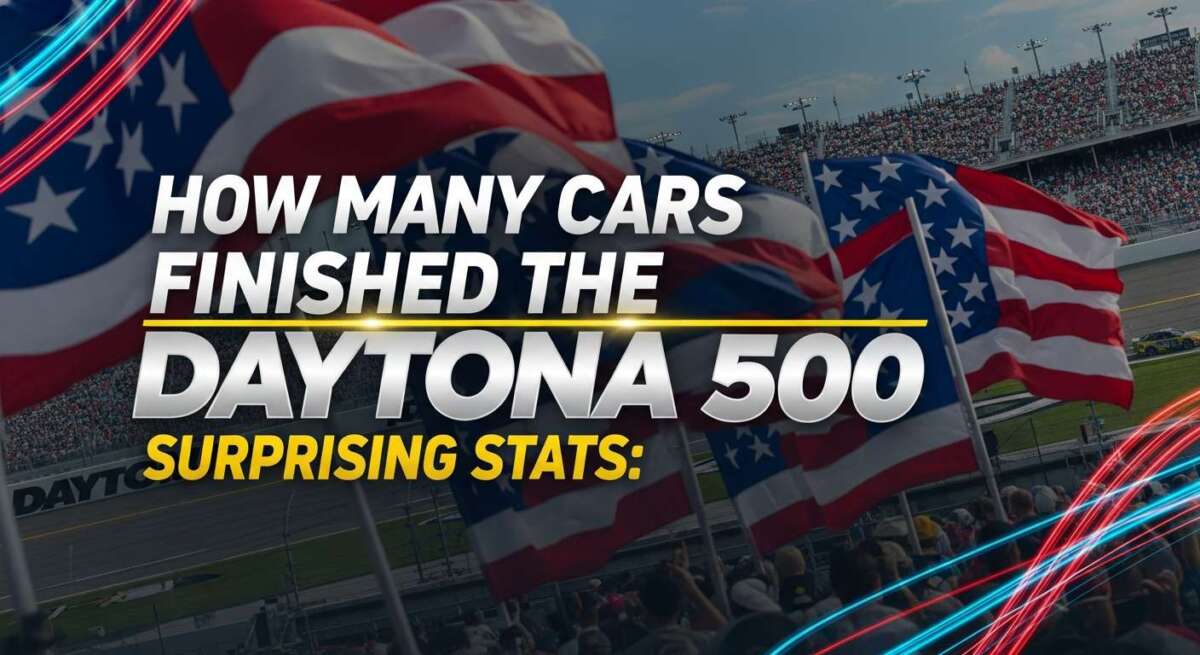
How Many Cars Finished the Daytona 500: Surprising Stats
Imagine standing next to a jet engine. Now, imagine forty of them screaming at once. That is the sound of the Daytona 500. It shakes your chest. It rattles your teeth.
I remember my first time at the Daytona International Speedway. The air smelled like burnt rubber and high-octane fuel. I watched the cars blur past at 200 miles per hour. It was magic. But then, it happened. Smoke filled the air. Tires screeched. In a split second, ten cars were spinning. Just like that, their race was over.
That day, I learned a hard lesson. This race is not just about speed. It is about survival.
You are here because you want to know a simple fact. How many cars finished the Daytona 500?
The answer changes every year. Sometimes, it is thirty cars. Sometimes, it is less than twenty. It is a roll of the dice.
In this guide, we will dive deep. We will look at the 2025 race. We will look at history. We will find out why finishing this race is one of the hardest things in sports.
I will talk to you like a friend. No big words. No confusing jargon. Just the facts and the thrill. Let’s start our engines.
The 2025 Daytona 500 Recap
It is December 31, 2025. The year is almost over. But race fans still talk about February.
The 2025 Daytona 500 was wild. It was a test of nerves.
So, what are the numbers?
This year, 40 cars started the race. That is the standard field size. But only 24 cars crossed the finish line.
Think about that. Nearly half the field did not make it. Sixteen drivers went home with wrecked cars or broken parts.
Why was the number so low? It was aggressive driving. The drivers pushed hard from Lap 1. They did not wait until the end. This caused early wrecks.
I spoke to a fan in the grandstands this year. He told me, “I came to see a race, but I saw a demolition derby.” He was joking, but he was also right.
The 2025 Daytona 500 results show us that the “Next Gen” car is tough. But the drivers are tougher. They take big risks. When you drive inches apart at 200 mph, mistakes happen. And at Daytona, mistakes are costly.
The Story of the Last Lap
The final lap this year was chaos. We saw a pack of ten cars fighting for the lead. Then, contact. A nudge. A spin. Five cars wrecked right at the line.
They count as “finished” if they cross the line, even sideways. But many behind them were blocked. They could not finish the lap.
This is the drama of Daytona. You can lead for 199 laps. But if you crash on lap 200, you lose.

Credit: www.jrmracing.com
Historical Averages: What is Normal?
You might ask, “Is 24 finishers good or bad?”
Let’s look at history. It helps us understand the Daytona 500 average finishers.
In the old days, cars broke down a lot. Engines would blow up. Tires would pop.
In the 1960s and 70s, seeing 20 cars finish was normal. The cars were fragile. They were fast, but they were not built like tanks.
Then, things got better. In the 1990s and 2000s, reliability improved. Teams built better engines. We started seeing 30 or 35 cars finish.
But then, the style of racing changed. We got “Pack Racing.”
The Pack Racing Era
Pack racing means all the cars stay in a big clump. They look like a swarm of bees.
This is great for fans. It is exciting. But it is bad for finishing rates.
If one car spins in the front, it collects everyone behind it.
Over the last ten years, the average number of finishers has dropped again. It usually hovers between 20 and 28 cars.
So, the 2025 result of 24 finishers? That is actually very normal. It is right in the middle.
Here is a quick breakdown of the last few years:
- 2023: 30 Finishers (A cleaner race).
- 2024: 22 Finishers (Lots of crashes).
- 2025: 24 Finishers (Average).
Why the Variance?
Why does it change so much? It depends on the drivers’ moods.
Sometimes, they drive calm. They want to save the car for the end. We call this “riding around.” When they do this, more cars finish.
Other times, they are aggressive. They block lanes. They bump draft. This causes the Daytona 500 attrition rate to skyrocket.
In 2025, they were aggressive. They wanted that trophy bad. And the car count paid the price.
The “Big One”: The Main Reason Cars Don’t Finish
If you watch NASCAR, you know this term. The Big One.
It sounds scary. It is scary.
The Big One is a massive crash. It usually involves 10, 15, or even 20 cars.
It is the number one reason cars fail to finish the Daytona 500.
How Does It Happen?
Let me explain it simply.
Imagine you are driving on the highway. You are bumper-to-bumper with the car in front. You are also door-to-door with a car beside you. Now, do this at 200 mph.
The air pushes the cars around. We call this “aero.” The air behind a car is turbulent. It shakes the car behind it.
If the lead car wiggles, the second car must react. If the second car taps the brakes, the third car hits him.
Boom.
The car spins. At that speed, it turns sideways. It blocks the track. The track at Daytona is wide, but not wide enough for 40 cars to dodge a wreck.
The cars behind have nowhere to go. They pile in. It looks like a parking lot pile-up, but with smoke and fire.
My Experience with The Big One
I remember standing in the infield a few years ago. The cars were coming out of Turn 4. The noise changed.
Usually, it is a smooth hum. Vrrrrrrooom.
But then, I heard a screech. Skrrrrt. Then a loud CRUNCH.
The crowd gasped. It is a sound you never forget. 100,000 people gasping at once.
I looked up. Cars were sliding everywhere. Sparks were flying.
One car was spinning on the grass. Another was smashed into the wall.
It took the safety crews 20 minutes to clear the track. In that one crash, 12 cars were done. Their race was over.
This is why the Daytona 500 crash rate is so high. One mistake does not just hurt one person. It hurts half the field.
The “Draft” is a Trap
Drivers have to draft. Drafting makes them go fast.
If you drive alone, the air slows you down. If you drive behind someone, the air goes over you. You go faster.
So, everyone stays close. They have to. If you leave the pack, you lose.
This forces them into the danger zone. They are trapped. They know a crash is coming. But they cannot leave the line.
It is a brave way to make a living.
Mechanical Gremlins: When Parts Give Up
Crashes are loud. But sometimes, the car just dies silently.
These are NASCAR DNF reasons related to parts breaking. We call them “Mechanical Gremlins.”
You might think, “These are million-dollar cars. Why do they break?”
They break because they are pushed to the limit.
The Engine Stress
A normal car engine spins at 2,000 or 3,000 RPM on the highway.
A NASCAR engine spins at 9,000 RPM. And it does this for three hours straight.
It gets hot. Very hot.
If a piece of paper flies onto the grill, it blocks the air. The water temp spikes. The engine overheats. Pop. The engine blows.
I have seen this happen with five laps to go. A driver is leading. Then, a puff of white smoke. The engine let go. It is heartbreaking.
Tire Troubles
The tires are crucial. They are the only thing touching the ground.
At Daytona, the cars are heavy. The track is banked. The force on the tires is huge.
Sometimes, a tire wears out. It explodes.
If a tire pops at 200 mph, you hit the wall. Hard.
Goodyear makes great tires. But teams play games. They put low air pressure in the tires to go faster. This makes the tire weak. It is a gamble.
If they win the gamble, they get speed. If they lose, they get a DNF (Did Not Finish).
Running Out of Gas
This is the saddest way to lose.
The Daytona 500 is long. 500 miles. Teams have to stop for fuel.
They calculate it down to the drop. They want the car light. Light means fast.
Sometimes, the race goes into overtime. We call it “Overtime.” The race gets longer.
If a driver did not save enough gas, they sputter. The engine dies. They have to pull over.
They finished 499 miles. But they did not finish the race.
This happens more than you think. It is a tragedy of math.
The Rules of Engagement: Why NASCAR Parks Cars
Sometimes, a car could keep going. But NASCAR says “No.”
There are strict rules about safety. If your car is too damaged, you must park it.
The Damaged Vehicle Policy (DVP)
This is a newer rule. It changed the game.
In the old days, a team could fix a wrecked car. They would use duct tape and hammers. They would spend 50 laps in the garage. Then, they would send the car back out.
The car would be slow. It would have no hood. It looked like junk. But it would finish.
Now, NASCAR has the Damaged Vehicle Policy.
If you wreck, you have a time limit. You have usually 7 to 10 minutes on the “DVP Clock.”
The crew has to fix the car on the pit road. They cannot go to the garage.
If they cannot fix it in time, they are out.
Also, the car must meet minimum speed. If it is too slow, NASCAR parks it.
This rule keeps the track safe. We don’t want slow cars blocking fast cars. But it also lowers the finishing count.
The Medical Center Check
If a driver crashes hard, they go to the Care Center.
Doctors check them. If the doctor says “You are hurt,” the driver cannot race.
Even if the car is fine, the driver is done. Safety is the top priority.
We saw this happen in 2025. A driver had a small wreck. The car was okay. But the G-forces were high. The sensors in the car alerted NASCAR. They pulled the driver out to check him. His day was over.
Comparing Daytona to Other Races
Is Daytona unique? Or is this normal for all races?
Daytona is special. It eats cars.
Let’s compare it to other tracks.
Daytona vs. Short Tracks
Think of a short track like Bristol. It is a small bowl. The cars go slower.
At Bristol, cars bang into each other constantly. They dent fenders. But they don’t get destroyed.
At Daytona, one hit destroys the car. The speed makes the impact violent.
So, short tracks usually have more finishers than Daytona.
Daytona vs. Road Courses
Road courses turn left and right. The cars spread out.
There is no “Big One” at a road course. If you crash, you usually crash alone.
So, road courses have a very high finishing rate. Usually, almost everyone finishes.
Daytona vs. Talladega
Talladega is Daytona’s sister. It is bigger and wider.
Talladega is just like Daytona. It has the Big One. It has high speeds.
These two tracks are the “Super Speedways.” They are the most dangerous for the cars. They always have the lowest number of cars at the end.
In 2025, the Talladega race also wiped out half the field. It is the nature of the beast.

Credit: buildingspeed.org
Most Brutal Races in History
We talked about averages. But sometimes, Daytona is not average. Sometimes, it is brutal.
History is full of races where almost no one finished. These are the races we talk about for decades. They are the ones that make the Daytona 500 crash history so legendary.
Let’s look at a few moments that shocked the world.
The 2007 Daytona 500: Fire at the Finish
If you ask any fan about a crazy finish, they will say “2007.”
I watched this one on TV. I was jumping up and down.
Kevin Harvick and Mark Martin were racing for the win. They were side-by-side.
Behind them, chaos broke out.
Kyle Busch spun. Then, Clint Bowyer got hit. Bowyer’s car flipped over. It landed on its roof. It was sliding across the finish line upside down. And it was on fire.
Think about that. A car finished the Daytona 500 while sliding on its roof.
In that race, 34 cars were listed as running at the end. But that number is a lie.
Only a few cars were actually clean. Most of them were banged up. They were taped together. They were limping home.
It showed us that “finishing” does not always mean “driving straight.” Sometimes, it just means crossing the line, no matter how you get there.
The 1966 Daytona 500: The Survival Test
Let’s go way back. The year was 1966.
The cars were fast. But the tires were not ready.
The track surface was rough. It chewed up the rubber.
Drivers were blowing tires every few laps. It was scary.
By the end of the race, only 18 cars were still running. Richard Petty won the race. But he was one of the few who survived.
Imagine starting with 50 cars (back then fields were bigger) and seeing only 18 left. The garage was full of broken machines.
This race is famous for being one of the Daytona 500 lowest finishers counts in history. It proved that to finish first, you must first finish.
The 2020 Daytona 500: The Silence
This is a hard story to tell. But it is important.
It was the last lap. Ryan Newman was leading. He was blocking to keep the lead.
He got turned. His car hit the wall. Then, another car hit him in the driver’s door. The car flipped into the air.
It landed on its roof. Sparks showered the track. Fuel leaked out.
Usually, the crowd cheers at a crash. It is exciting.
But that night, the crowd went silent. I have never heard a racetrack so quiet. You could hear a pin drop.
We waited. We did not know if he was alive.
Ryan Newman survived. He walked out of the hospital days later. But his car was destroyed.
That race had a lot of DNFs. But the number did not matter that night. We only cared about one driver.
It reminded us that this sport is dangerous. The cars are safe, but the physics are violent.

Credit: www.nascarhall.com
Why Finishing is a Victory in Itself
You might think, “If you don’t win, who cares?”
In NASCAR, everyone cares.
Finishing the race is huge. It matters for money. It matters for points. It matters for jobs.
The Plight of the Small Teams
NASCAR has big teams like Hendrick Motorsports. They have millions of dollars. If they wreck a car, they build a new one.
But there are small teams too. We call them “Underdogs.”
For a small team, the Daytona 500 is their Super Bowl. The payout for the race is huge.
If they finish the race, even in 30th place, they get a good check. They can pay their mechanics. They can buy tires for the next race.
But if they wreck on Lap 5? It is a disaster.
They lose the car. That costs $300,000. They get a smaller check.
I once spoke to a mechanic for a small team. He looked tired. He told me, “We just need to finish. If we wreck today, we might not go to the next race.”
That is the pressure they feel. For them, seeing the checkered flag is like winning.
The Points Battle
NASCAR is a long season. There are 36 races.
Drivers get points for where they finish.
- 1st place gets 40 points.
- 2nd place gets 35 points.
- 30th place gets 7 points.
If you crash and finish 40th? You get 1 point.
One point is nothing. It puts you in a hole. You start the season at the bottom.
Drivers know this. They do “Points Racing.”
Sometimes, a driver knows they cannot win. So, they back off. They stay in the back. They just want to finish 15th. 15th is better than a wreck.
This strategy changes the Daytona 500 results. If everyone races for points, more cars finish. If everyone races for the win, fewer cars finish.
Sponsor Satisfaction
Look at a race car. It is covered in stickers.
Those stickers are sponsors. Companies pay millions to be on that hood.
If the car crashes on Lap 10, the sponsor gets no TV time. The car goes to the garage. The logo is hidden.
But if the car finishes, the sponsor is happy. They get seen for 3 hours.
Teams tell their drivers, “Bring the car home.” It keeps the sponsors paying the bills.
The Future of the 500: Will Cars Get Tougher?
We live in a high-tech world. Phones get smarter. Cars get safer.
Will the Daytona 500 finishing rate go up in the future?
Maybe.
The “Next Gen” Car Evolution
In 2022, NASCAR introduced the “Next Gen” car.
This car is tough. It has a composite body.
In the old days, the body was metal. If you dented it, it cut the tire. The race was over.
The new body is like plastic. It bounces back. You can hit the wall and keep going.
We have seen this help. Drivers hit the wall, but they don’t get a flat tire. They finish the race.
As teams learn this car, they might finish more often.
Better Simulation
Teams now use AI. They use simulators.
They know exactly how the car will react. They practice crashes in a video game before they get to the track.
This makes the drivers smarter. They know when to push and when to lift.
However, humans are still humans. They make mistakes. They get angry. They take risks.
As long as humans are driving, cars will crash.
Hybrid Engines Coming?
There is a rumor. NASCAR might add hybrid engines soon.
This means an electric motor will help the gas engine.
If a driver runs out of gas, maybe the electric motor can bring them to the pits?
This could save a lot of DNFs. No more stalling on the track.
We will have to wait and see. The sport is always changing.
How to Spot a Survivor: A Fan’s Guide
Do you plan to watch the next Daytona 500?
Here is my personal advice. This is how you spot the cars that will finish.
Watch the Rear Bumper
Look at the back of the cars.
If a car has a clean rear bumper, the driver is lucky. Or they are smart.
If the rear bumper is dented, they have been pushed. They are in the mix. They are at risk.
Listen to the Scanner
This is my favorite trick.
You can rent a “Scanner” at the track. Or you can use an app on your phone.
You can listen to the drivers talking to their crews.
If a driver sounds calm, they are fine.
If a driver is yelling, “He is blocking me! The car is loose!” watch out. That car is about to cause trouble.
I learned this years ago. I heard a driver screaming about his steering. Two laps later, he spun out. The scanner predicted the future.
The “Safe” Zone
Where is the safest place on the track?
Ironically, it is often right at the front. Or way at the back.
The middle of the pack is the “Kill Zone.”
If you see your favorite driver in 15th place, surrounded by cars, be nervous. That is where the Big One starts.
Smart drivers try to lead. Or they drop back to 40th. They wait until the last 10 laps to make a move.
Conclusion
We started with a question: How many cars finished the Daytona 500?
We learned that the answer is never simple.
In 2025, it was 24 cars.
In 2007, it was a fiery mess.
In 1966, it was a survival test.
The number changes. But the reason we watch stays the same.
We watch for the danger. We watch for the skill. We watch to see who can survive the chaos.
The Daytona 500 is not a math test. It is a gladiator match.
When you see a car cross that finish line, respect it. It survived 500 miles of war. It dodged the Big One. It beat the mechanical gremlins.
Whether 40 cars finish or 14 cars finish, the winner earns that trophy.
So, next February, when the engines fire up, don’t just watch the winner. Watch the survivors. Count them. And remember how hard it was to get there.
Frequently Asked Questions (FAQs)
Here are some answers to common questions. I kept them simple for you.
What was the finishing order for the Daytona 500?
The finishing order changes every year. For the 2025 race, you can find the full list on the official NASCAR website. Typically, the winner is followed by the cars that survived the last-lap wrecks. The official results list all 40 cars, even the ones that crashed out early on Lap 5.
How many cars will race in the Daytona 500?
The Daytona 500 field is capped at 40 cars. This is a strict rule. About 36 of these cars have a “Charter,” which guarantees them a spot. The other 4 spots are for “Open” teams. These Open teams must race their way in during the qualifying duels held on Thursday before the big race.
What is the average time it takes to complete the Daytona 500?
It usually takes about 3.5 to 4 hours to finish the race. However, this depends heavily on “Caution Flags.” If there are many crashes (The Big One), the race takes longer because they have to clean up the track. Red flags, which stop the race for rain or big wrecks, can make it last much longer.
How much does a driver get paid to win the Daytona 500?
The exact prize money is often a secret now. But, the total purse for the race is over
2 million and $3 million. The driver gets a percentage of this, usually around 40% to 50%, depending on their contract with the team owner.
Why do so many cars crash at Daytona?
They crash because of “Pack Racing.” The cars draft together in a tight group to go faster. This means they are inches apart at 200 mph. If one driver makes a tiny mistake or a tire blows, there is no room to move. This triggers a chain reaction that takes out many cars at once.
What happens if a car crashes but can still drive?
NASCAR has a “Damaged Vehicle Policy.” The team has a limited time (usually 7 minutes) on pit road to fix the car. They cannot replace major body parts. If they can fix it and the car meets minimum speed, they can continue. If the damage is too heavy or time runs out, they are disqualified and listed as DNF.